
Autobid
Autobid automatically adjusts an ad's bid to work towards a target return on ad spend.
Overview
Autobid is Kevel's automated bidding strategy for working towards a return on ad spend (ROAS) target.
You set the budget, the maximum CPC/CPA/CPM bid, and a target ROAS. Kevel's Ad Decision Engine then adjusts the bid on each auction: bidding up while an ad is performing ahead of its target, and down while it is behind. The effect is that spend is directed towards the impressions most likely to generate sales, rather than spread evenly.
Autobid optimises each ad individually, against that ad's lifetime ROAS.
Prerequisites
ROAS is calculated as GMV ÷ Revenue, so Autobid needs both values flowing for any flight you want it to optimise:
- GMV comes from attributed purchase events. See GMV and ROAS for how to record it.
- Revenue, meaning advertiser spend, is tracked automatically from click events and the final bid price.
If GMV is not being recorded against a flight, Autobid has nothing to optimise against.
Choosing a target
A workable target varies greatly across customers, advertisers, and the items being promoted, so reach out to your Kevel contact to discuss what fits your business.
If this is your first time tracking ROAS for your advertisers, Kevel recommends running a CPC, CPA, or CPM bid strategy first to establish the average ROAS you actually achieve. Once you know the typical ROAS for that advertiser and product category, you can set a target from evidence rather than a guess.
Turning on Autobid
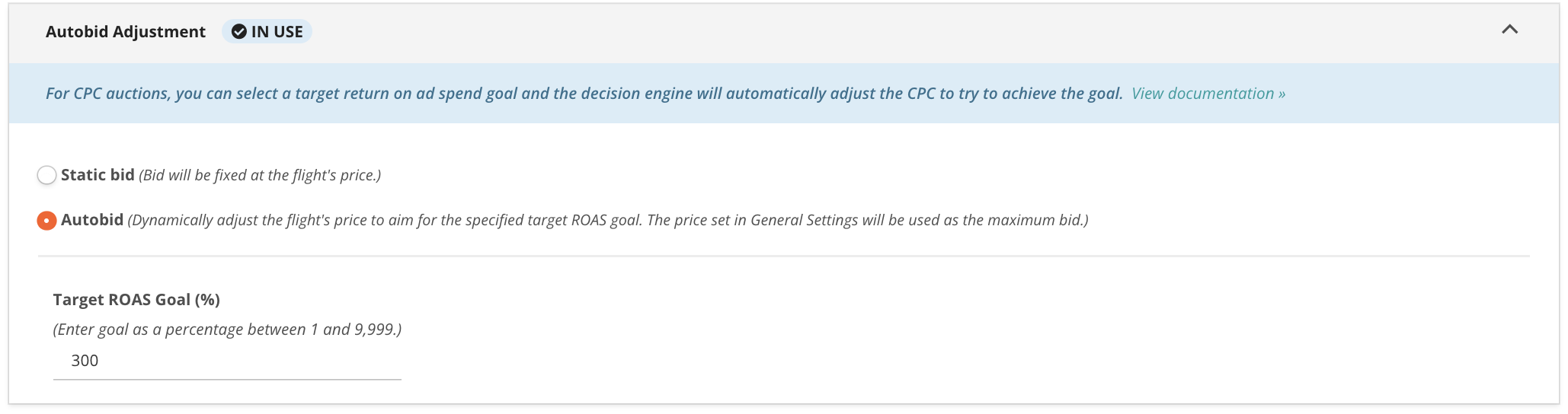
Autobid is configured per flight, either in the UI under the flight's settings or through the Create Flight endpoint.
Setting up Autobid via the APISet
TargetROASto a float between0.01and99.99, equivalent to 1% and 9,999%. Once a target is set, the decision engine adjusts the bid automatically to work towards it.
Priceacts as the maximum bid.
What to expect
Autobid starts cautiously
A new flight has no performance history, so Autobid begins with low bids and increases them as data arrives. This is deliberate: there is usually a lag between a click and the resulting purchase, so early GMV data is incomplete, and bidding aggressively before it lands tends to overspend against the target.
While a flight is still in its learning phase, the bid starts from the default eCPM configured on the flight and moves towards the ad's own measured performance as impressions accrue. A very low default eCPM makes this opening period slower, because the ad wins fewer auctions and so gathers performance data more slowly.
Most flights settle into a stable bidding pattern within a few hours.
Whether the budget is spent depends on the gap to target
The likeliest question about an Autobid flight is why it did or did not spend. That follows from how the ad's actual ROAS compares to the target:
| Situation | What Autobid does | Effect on delivery |
|---|---|---|
| Actual ROAS is below target | Lowers bids to avoid overspending against the target | The ad is less competitive and wins fewer impressions, so the flight is less likely to spend its budget. If delivery falls far enough behind, Autobid increases auction participation. |
| Actual ROAS is above target | Raises bids, since there is room to buy more sales and still meet the target | The ad is more competitive, so the flight is more likely to spend its budget. |
The target is a benchmark, not a guarantee
Whether a target is reachable depends on available inventory and the bids an ad is competing against. Autobid works towards the target within those constraints and gets as close as the auction allows, but a target that is more efficient than the inventory can support will not be met.
Limits and interactions
Autobid adjusts the bid within limits you already control, and never outside them:
- Maximum bid. Autobid cannot bid above the flight's
Price, or the ad's price when an ad-level override is set. - Floor prices. A Priority's Floor Price (an eCPM) and Floor CPC still apply, so bids are raised where needed to stay eligible for the auction.
- Budget caps. Caps at the flight, campaign, and advertiser levels are all enforced independently of the ROAS target.
- Bid modifiers. Autobid can be combined with bid modifiers. The highest matched modifier price becomes the ceiling that Autobid then adjusts within, which raises the ceiling above the flight's base price.
- Per-ID bid modifiers. Bids cannot be set directly in an ad decision request, but you can influence them per ID. See Per-ID Bid Modifiers in ADRs.
Changing a target on a live flight
A new target takes effect as soon as Autobid picks it up. A large change produces correspondingly aggressive bidding while the ad moves towards the new target, so it is worth adjusting targets in smaller steps on a flight that is already delivering as intended.
Updated 3 months ago