
How Pacing and Balancing Work
How Kevel decides which flights serve and how often: weights, lotteries and auctions, and how pacing adjusts them.
Who this is forThis page explains how Kevel decides which flights serve, and how often. It is useful for understanding delivery at an advanced level and for troubleshooting. For each goal type and how it paces, see Ad Pacing (Goals). Networks can differ in how weights are applied, and the Decision Explainer shows the weight each flight carried for a request.
How pacing works
Goals let Kevel plan delivery and adjust it as flights serve. This supports three outcomes:
- A flight can have a goal. Delivery is planned so the flight reaches its goal by its End Date, or each day or month for Daily and Monthly Revenue goals. The plan runs a little ahead of a straight line, so the end of the flight or day is not rushed. A Monthly Revenue goal plans a straight line across the month. Actual delivery varies with traffic.
- When supply exceeds demand, all demand is filled. In a priority that uses second-price rules, flights do not compete for impressions when there are more than enough to go round, so they clear at the floor price. Flights set to Percentage, and flights with no goal, take part in every auction.
- Competition ramps up smoothly when demand exceeds supply. Flights compete only when several want the same impression at the same time to meet their goals. The pacing needs of the flights decide how often they meet in auctions.
Weights, pacing and balancing
Two ideas work together to regulate how fast a flight serves:
- Pacing: each flight has a weight, which is the share of eligible requests it may take part in, from 0 to 100%. For each request, a lottery decides which flights may serve or, in an auction priority, which may bid. Weights are measured against a pool of tickets of fixed size that Kevel sets, not one you configure.
- Balancing: Kevel measures how each flight is delivering and adjusts its weight while it serves, so the flight stays on its plan. Each flight is re-evaluated regularly from its recent delivery. A new flight ramps up from a small share rather than starting at full strength.
On most networks the weight belongs to the flight. In a lottery priority it is split among the eligible ads in the flight. In an auction priority the flight is drawn once, and all of its eligible ads bid. An ad that carries its own goal keeps its own weight, and some networks use a weight per ad. Ask your Kevel account team which applies to your network.
Pacing is a rate-limiting function. Kevel cannot serve more impressions than the available inventory allows, so the only way to regulate the pace is to limit how fast flights serve. In an auction priority, a weight decides which ads may bid on a request. It does not change an ad's relevancy score, eCPM or Ad Rank, but it can change the price a winner pays. See Pacing and auctions.
For example, take three flights, A, B and C, in the same priority:
- A starts to fall behind its plan, so it needs to serve faster.
- Kevel measures A's delivery and raises its weight, so A takes part in a larger share of requests.
- Each flight has its own plan. A larger share for A leaves less for the others only when the weights in a lottery add up to more than the pool holds. If B or C then falls behind, its own weight rises in turn.
- If A overshoots its plan, its weight falls, and the cycle repeats.
Lotteries
A lottery is how Kevel turns weights into a decision. In a lottery priority, each flight gets a share of the eligible requests in proportion to its weight. Only one flight wins each draw, and flights do not compete in an auction.
Each flight is given lottery tickets according to its weight. The tickets go into a pool, and one is picked at random. Whichever flight holds that ticket wins.
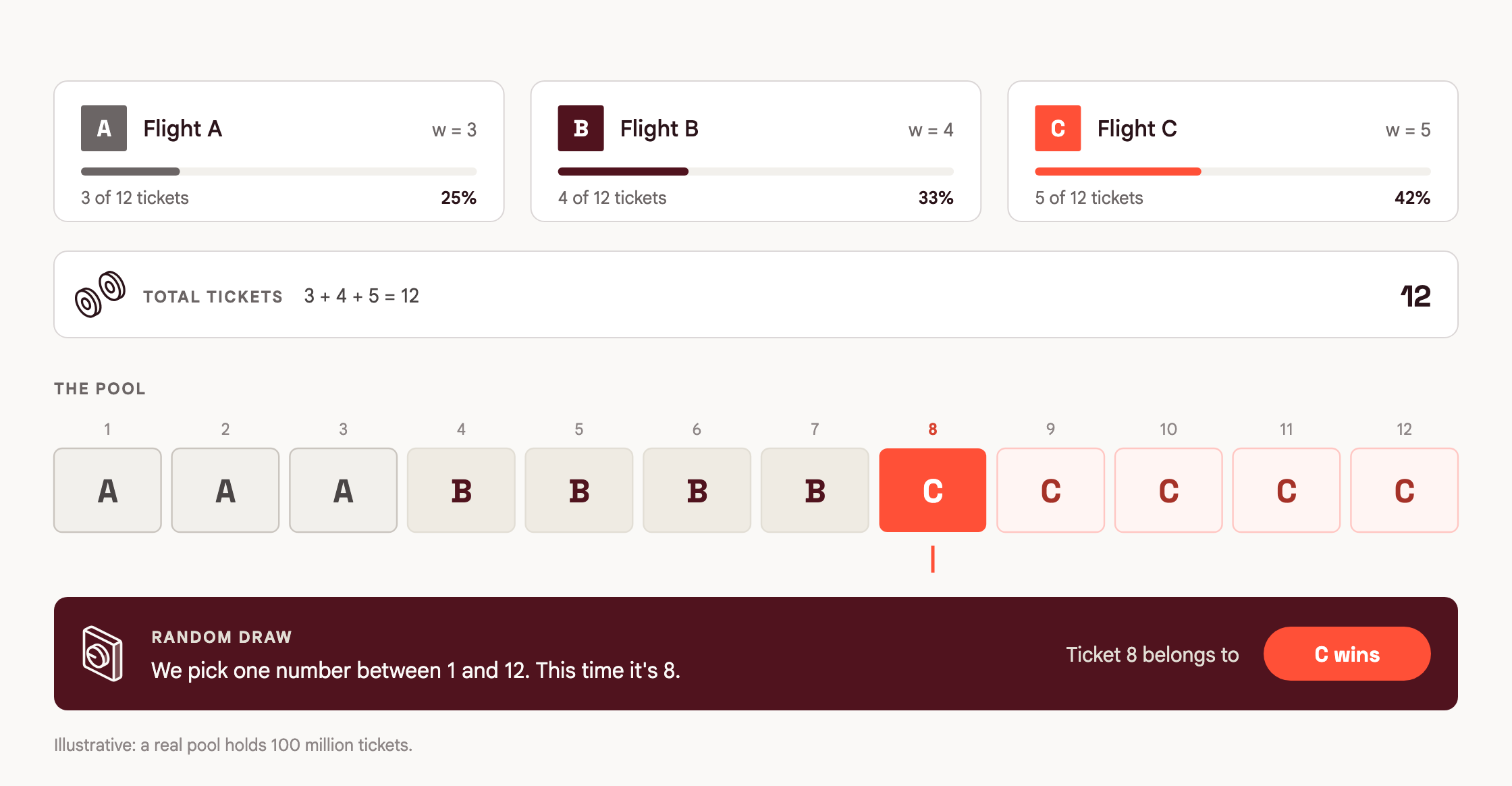
The probability that a flight wins is proportional to its weight, and because the winner is chosen at random, every flight gets its share of requests over time.
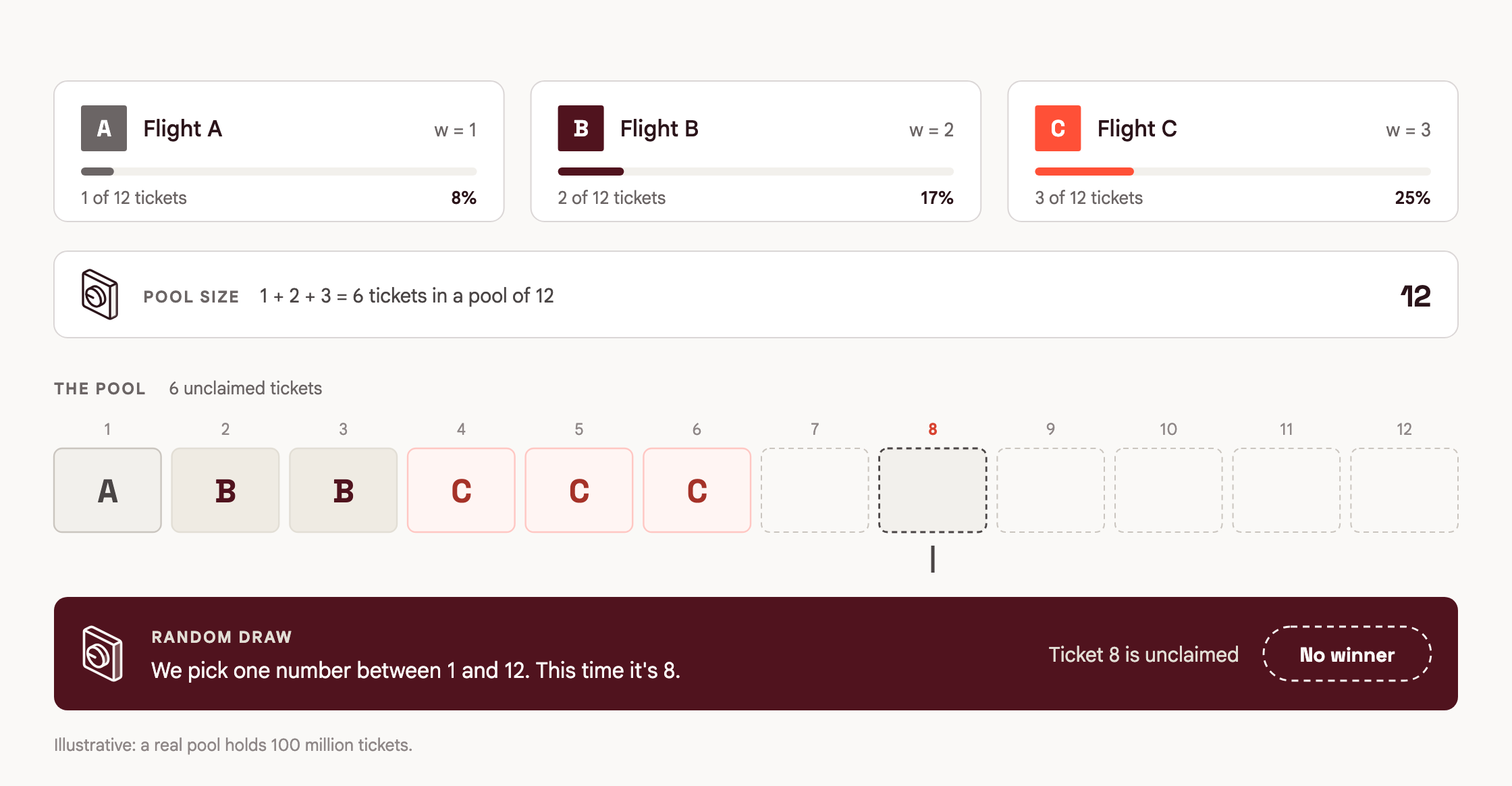
That example is slightly misleading, because it implies that a lottery always picks a winner. When inventory exceeds demand, flights would then overshoot their goals. To prevent that, weights are measured against a pool of fixed size, and any ticket that no flight holds stays unclaimed. If the draw lands on an unclaimed ticket, nobody wins and the request falls through to the next priority.
So when supply is greater than demand:
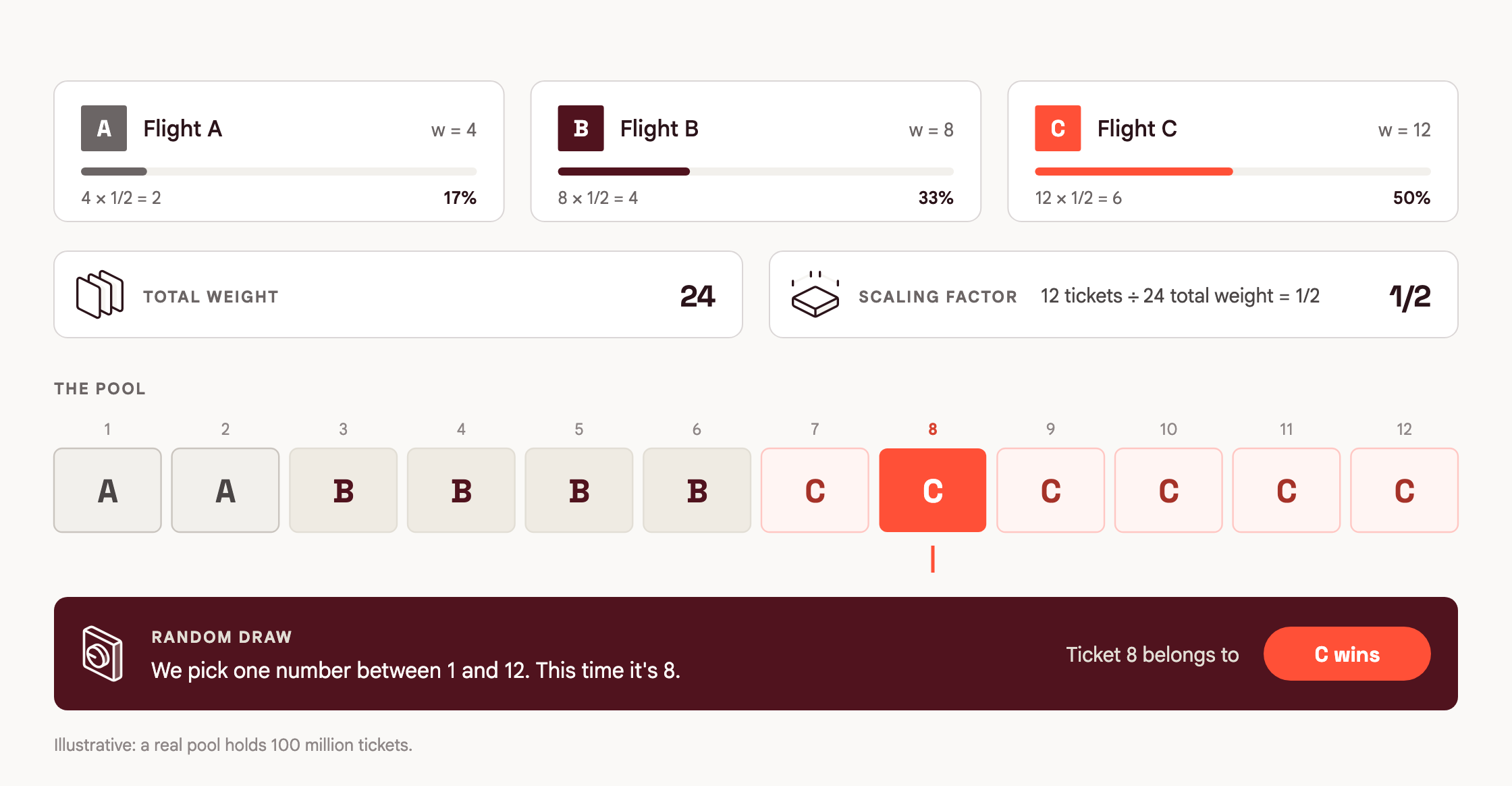
And when demand is greater than supply, so the weights add up to more than the pool holds, every weight is scaled down by the same factor:
Two more rules apply in a lottery priority:
- Percentage flights draw first. Flights with a Percentage goal draw before flights that are paced, and paced flights only get the requests the Percentage flights leave. A flight set to Percentage 100 therefore leaves nothing for paced flights in the same priority.
- Placements with several slots draw again. Each slot gets its own draw.
Paced and balanced auctions
In a lottery priority only one flight can win a draw, even when demand exceeds supply. Paced auctions need several flights to compete for the same impression in that case, while still pacing each one to its goal.
Kevel does this with a modified lottery before the auction. The pre-auction lottery selects the flights that may bid, and then the auction decides which of them wins the impression.
The ideas of weight and pool size carry over, but when demand is greater than supply the weights are not scaled down. Instead, Kevel runs a series of lotteries, each with a possible winner. The rules are designed so that at least one flight wins across the series whenever demand meets or exceeds supply.
Consider the last example above, where demand is twice supply: the flights need twice as many impressions per second to reach their goals as are available in the priority.
A: weight =  4
B: weight =  8
C: weight = 12
First, the flights are shuffled into a random order, say B, C, A, and each claims lottery tickets according to its weight, in that order, from the tickets still available. A has 4 tickets, B has 8, and so on. The first lottery is built from those tickets, and a winner is drawn:
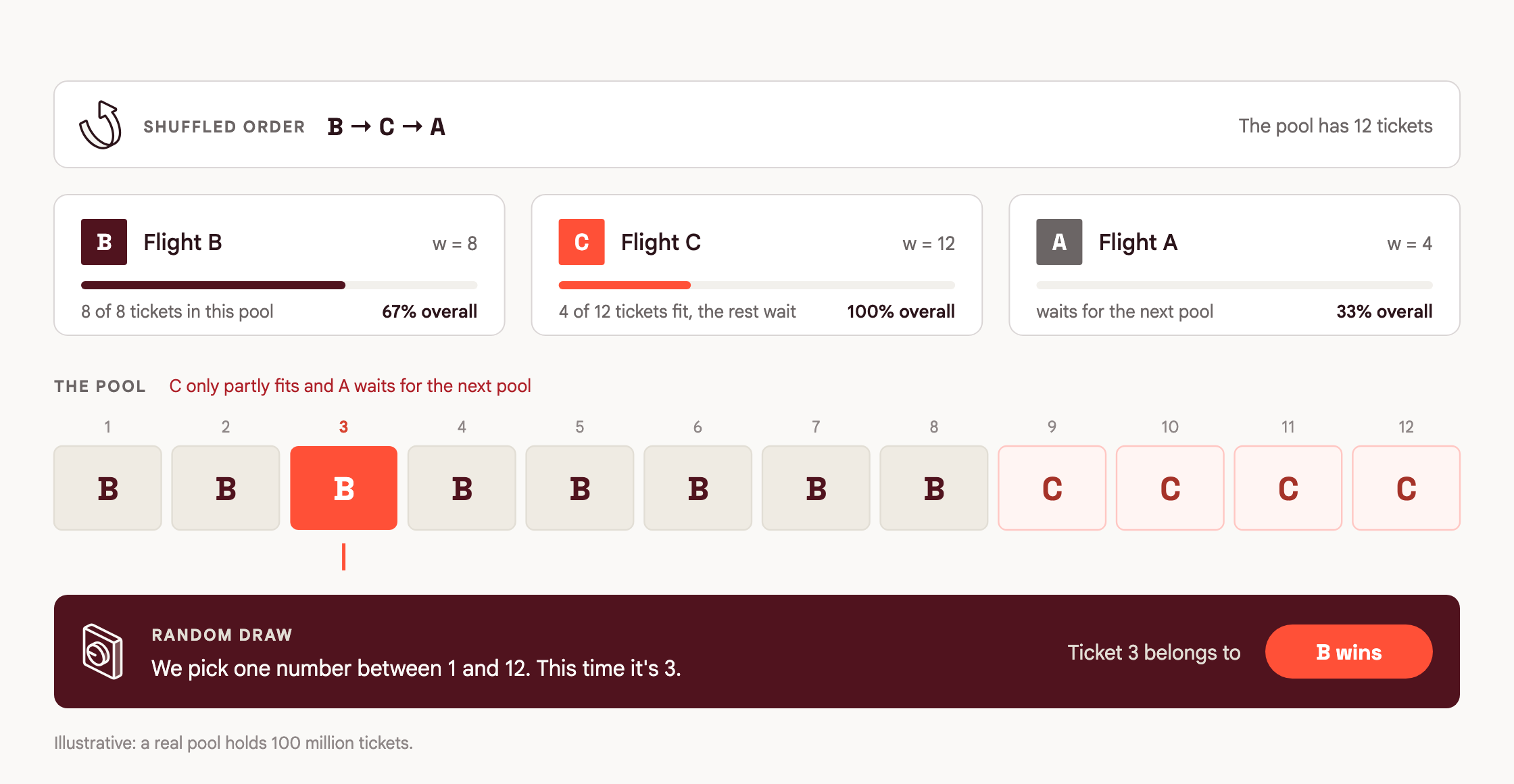
B won the first lottery, and C lost. But C only got to play 4 of its 12 tickets, so it plays the rest in the next lottery. The shuffle decides which flights share a pool, not who gets a chance: a flight that does not fit waits for the next pool, and its odds do not change.
Letting C play in two lotteries would change its odds. Splitting its tickets between two lotteries gives it a slightly lower chance of winning a lottery than playing them all in one. To correct this, the number of tickets C plays in the next lottery is prorated so that its total probability is preserved:
The prorated probability for the second lottery is
y = (p - x) / (1 - x)where y is the prorated probability, x is the probability of winning the first lottery, and p is the original probability for the flight's weight.
A second lottery is built with C's remaining tickets plus the adjustment, which works out to 4 extra tickets for a total of 12, and as many of A's tickets as there are tickets left. C won this lottery, but A again did not get to play, so a third lottery is built in which A plays its 4 tickets:
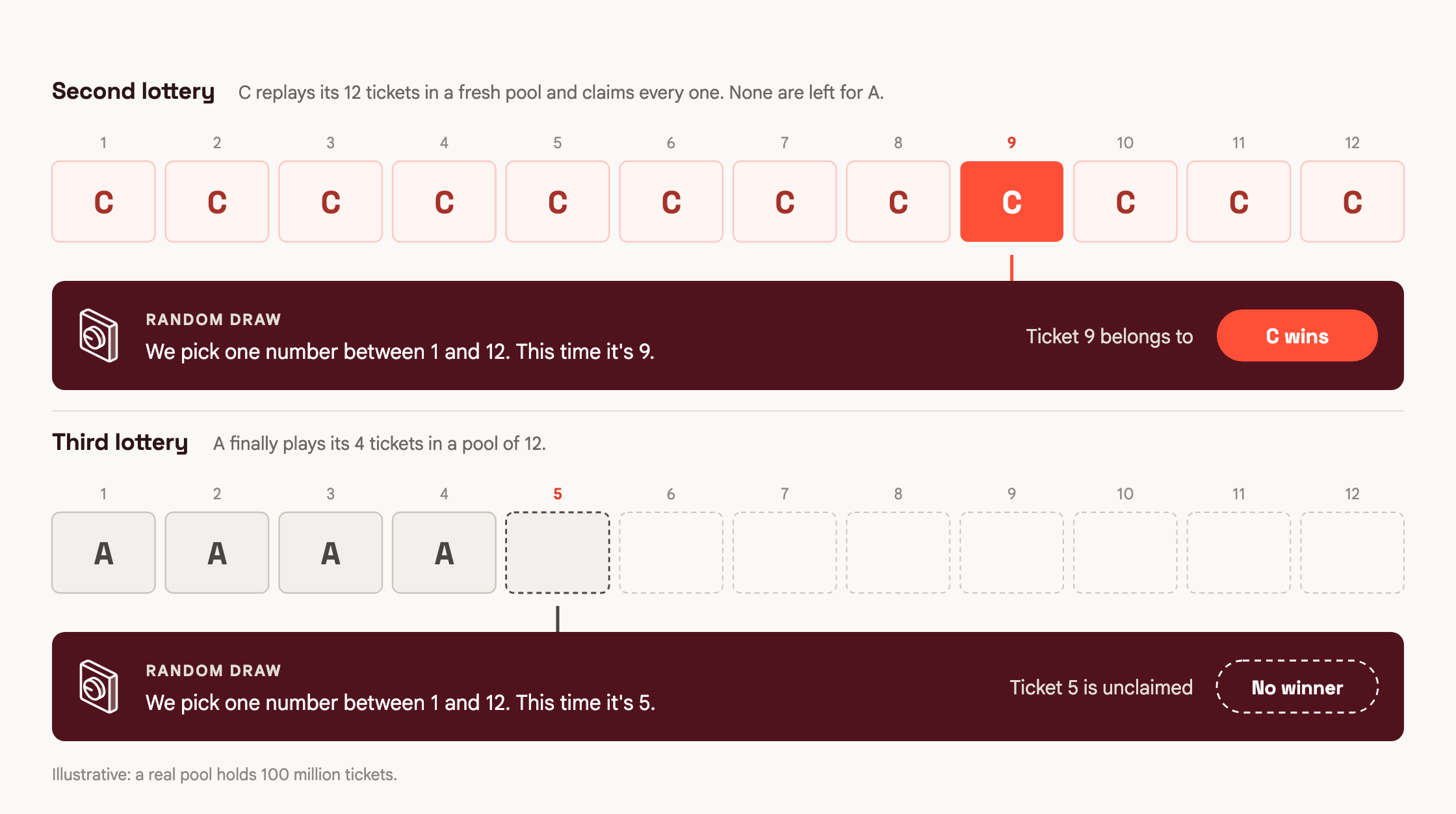
Now no tickets are left, so the series is complete. The winners, B and C, move on to the auction, where they bid against each other to win the impression. In a priority that uses second-price rules, the winner pays the least it needed to beat the runner-up, plus one cent, not its own bid. See Second Price Auctions.
Pacing and auctions
In an auction priority, pacing decides which ads are let into the auction on each request. The auction then ranks the ads that were let in.
- The weight is the chance of being let in. An ad with a weight of 40% is let into about 40% of the auctions it is eligible for. An ad at 100% is let into all of them. Flights set to Percentage, and flights with no goal, always take part.
- Pacing does not change an ad's relevancy score, eCPM or Ad Rank. An ad that is let in ranks exactly as it would without pacing. Autobid is a separate setting that changes the bid, and with it the eCPM.
- Pacing can change the price. In a second price priority, the runner-up sets the winner's price, and the runner-up is chosen from the ads that were let in. An ad that was kept out on this request cannot set the price. The same two ads can clear at the runner-up's price on one request and at the floor price on the next.
- At full weight, pacing has nothing more to give. An ad at 100% is let into every auction it is eligible for. If it is still behind, check two things. Is it eligible: targeting, caps and floor price. And how does it rank: bid, eCPM and relevancy score. A flight that is behind can still lose every auction it enters.
- If no ad is let in, the request moves on. When pacing keeps every ad out of the auction, the priority selects nothing and Kevel tries the next priority. A lower priority, such as house ads, can then serve while auction ads are eligible.
- In a lottery priority, the weight is the chance of winning. A lottery does not rank ads, so eCPM and relevancy scores do not apply.
Site relevancy scores change an ad's weight. They do not change its Ad Rank. See Sites.
What to expect
Balancing is a continuous process, so weights keep changing as flights deliver and as inventory and demand ebb and flow.
To get a feel for how paced and balanced auctions behave, consider the range of outcomes in the example. B and C were chosen this time, but the series could have produced A and C, or A, B and C. Over many requests, the flights that enter the auction work out to roughly this mix:
| Flights in the auction | Share of requests |
|---|---|
| B and C | About 59% |
| A and C | About 26% |
| A, B and C | About 7% |
| C alone | About 7% |
- Why is C in every outcome? C has the maximum weight, so it wants every available impression. It is sure to win one of the lotteries in the series, so it always bids.
- How likely is it for C to bid against A, B or both? A's weight is 4, so it wins a lottery in the series about 4/12, or 33%, of the time. B's weight is 8, so it wins about 8/12, or 67%, of the time. Whenever A or B wins a lottery, it may bid.
- Why does C sometimes bid against A, sometimes against B, and sometimes both? Both A and B want some inventory, and because C wants all of it, they must bid against C to get their share. Auctions with two flights are more common than auctions with all three.
- What effective CPM should we expect? If the priority uses second-price rules, the price depends on who C bids against. Against A or B, it pays one cent more than it needed to beat the runner-up. When C is alone in the auction, it clears at the floor price. So the effective CPM of a flight depends on the mix of competitors, not only on its own bid.
Related
- Ad Pacing (Goals): goal types, cycles, daily caps and capacity-aware pacing
- Ad Capping
- Decision Explainer: see the weight each flight carried for a request
- Autobid: a separate lever that changes the bid in auction priorities
Updated 1 day ago